
What Does the Solution Offer?
Despite the rapid development of mobile communication networks worldwide in recent years, some special areas still suffer from a lack of mobile signal coverage. These include project sites far from urban areas, offshore production platforms, and small industrial parks or infrastructures far from cities. Because the coverage needs of these locations are temporary and mobile, telecom operators are typically unwilling to invest heavily in building fixed-site cellular network base stations for them.
YSF’s Microwave Remote Repeater Solution was developed precisely to address this issue. It uses microwave links, which are based on license-exempt bands to extend mobile signals from the original donor base station area to the target area, thereby providing mobile signal coverage there. It solves the coverage problem at a highly cost-effective way bypassing the installation of fiber optic cable that is generally required by the typical fiber remote repeater solution. Furthermore, the low-power design of the remote unit makes it possible to power the Remote Unit using a self-sustaining photovoltaic system.
Typical Application Scenarios:
- Remote project camps in the wilderness
- Rural areas with less network traffic needed
- Remote offshore production platform on the sea
- Remote industry park with less network traffic needed
- Short to medium term temporary facilities
Solution Overview
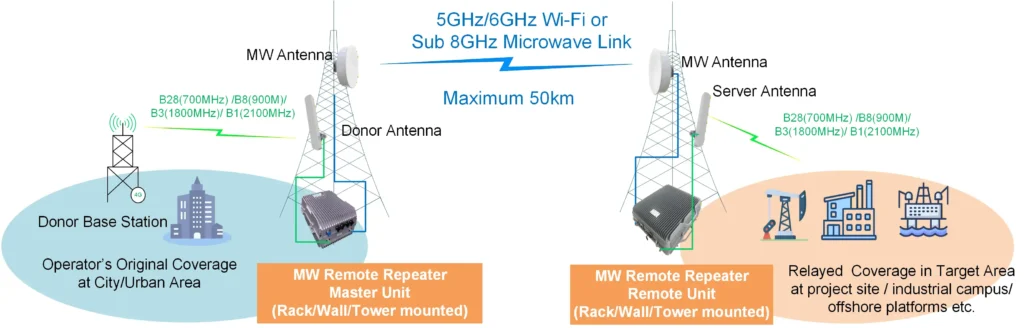
Solution typical networking:
The system basically consists of two parts, the Master Unit and the Remote Unit. The Master Unit is installed at the local site where mobile signal from Donor Base Station is good and stable, while the Remote Unit is installed at the remote site to cover the targeted area. The maximum distance between local and remote sites is 50 Km.
The down-link signal flow is as follows:
At the local site, the Master Unit receives mobile cellular signal from the donor Base Station, then converts it into a microwave signal (by shifting the frequency from cellular bands to license-exempt bands) and sends it to the remote site via the microwave link.
At the remote site, the Remote Unit receives the microwave signal from the microwave link, then converts it back into the mobile cellular signal and transmits it out through the service Antenna to cover the target area.
The up-link signal flow is as follows:
At the remote site, the Remote Unit receives mobile cellular signal from user cellphones, then converts it into a microwave signal(by shifting the frequency from cellular bands to the license-exempt bands) and sends it back to the local site by the microwave link.
At the local site, the Master Unit receives the microwave signal from the microwave link, then converts it back into the mobile cellular signal and sends it back to the Donor Base Station through the Donor Antenna.
Solution Application Constraints:
- The path between MW antennas should be a Line-of-sight(LOS) path;
- Make sure there is no interference to the Microwave link on the LOS path, as the link is running at a license-exempt band(normally the 5G/6G Wi-Fi bands, 5.15 – 5.85GHz or 5.925 – 7.125GHz etc. Can be adjustable within 8GHz according to local regulations and laws.)
- Make sure the relayed coverage in the targeted area will not affect telecom operators’ existing cellular network coverage.
- Supported Network Mode: GSM 2G /WCDMA 3G/ FDD LTE 4G / TDD LTE 4G
Click here for more techinical specifications of the Microwave Repeater MU and RU.